China’s CNC machining sector has become a serious choice for aerospace, automotive, medical, robotics, and industrial equipment companies. A reliable cnc machining part supplier must offer more than competitive pricing. It should demonstrate process control, material knowledge, inspection discipline, and consistent delivery.
This guide examines ten leading Chinese manufacturers through practical criteria. These include machining capability, tolerance control, equipment quality, surface finishing, engineering support, production capacity, certifications, and communication. A polished website is not enough. Real confidence comes from measured samples, clear drawings, inspection reports, and traceable production records.
Manufacturing researcher Dr. David A. Dornfeld has emphasized, “Sustainable manufacturing requires reducing the environmental impact of manufacturing processes.” His point remains relevant here. Modern buyers should examine waste reduction, energy use, material efficiency, and responsible supplier practices. Cost still matters. It should not stand alone.
The selected companies may serve different needs. One may excel at rapid prototypes. Another may handle complex five-axis components. A third may provide stable volume production for aluminum housings or stainless-steel shafts. Their strengths are not identical.
That matters.
Choosing the wrong partner can create burrs, warped parts, late shipments, or costly rework. Even experienced purchasing teams sometimes overlook inspection methods and engineering responsiveness. This list is therefore a useful starting point, not a final verdict. Readers should verify current certifications, machine lists, sample quality, and communication before placing a production order. CNC machining changes quickly, and supplier performance can change too.
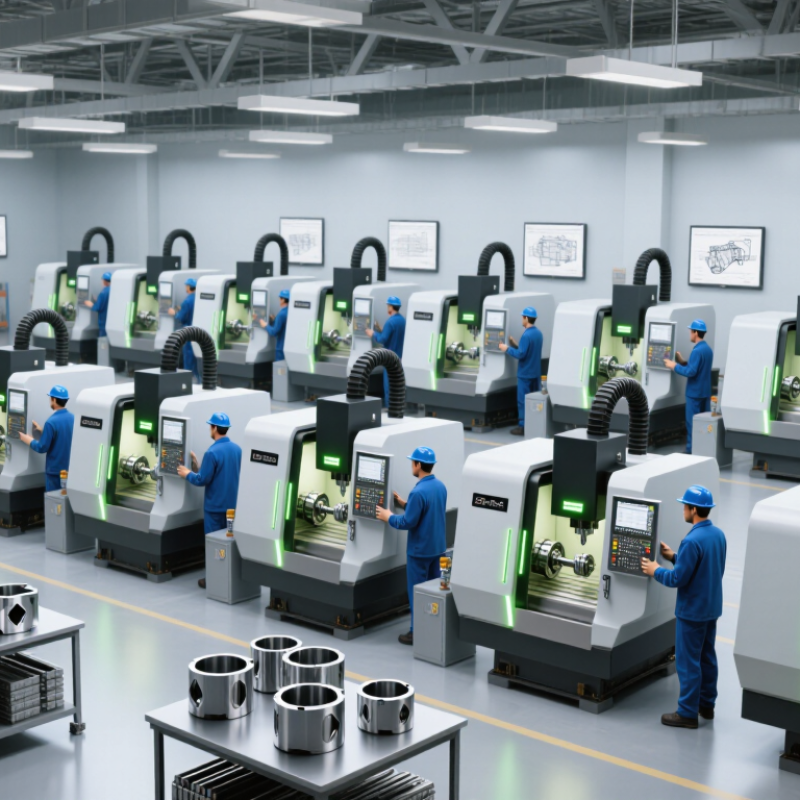
China’s CNC machining part manufacturers should be evaluated beyond low quotations. A polished factory tour proves little. The stronger test is consistent evidence across quality, capacity, engineering, and delivery.
The International Federation of Robotics reported 276,288 industrial robots installed in China during 2023. This represented about 51% of global installations. The figure suggests strong automation potential, but it does not prove machining accuracy. Buyers should request recent capability studies, CMM inspection records, material certificates, and traceability samples. Process control matters more than impressive equipment lists. Critical checks include tool-wear monitoring, first-article approval, surface-finish results, and corrective-action speed.
For a credible top-ten assessment, weighted scoring is useful. Quality systems may receive 30%, technical capability 25%, delivery reliability 20%, cost control 15%, and communication 10%. China Machine Tool Industry Association reports can help assess domestic industry conditions. UN Comtrade data can provide export context, although it does not isolate CNC machining parts perfectly. That limitation deserves attention. A supplier may export large volumes while outsourcing complex operations. Another may have excellent prototypes but weak production discipline. Site audits should compare promised tolerances with measured parts, especially around thin walls, deep holes, and threaded features. Rankings remain imperfect without long-term defect data. Trial orders are still necessary.
China’s top ten CNC machining part manufacturers should be ranked by evidence, not advertising. A polished website proves very little. Reliable evaluation begins with production experience, engineering depth, and repeatable quality control. Factory visits can reveal useful details, such as organized workstations, labeled material batches, and calibrated measuring tools.
Technical capability deserves close attention. Strong manufacturers should handle suitable metals, plastics, tolerances, surface treatments, and complex geometries. Inspectors should use micrometers, height gauges, and coordinate measuring machines when required. Ask for inspection reports, material certificates, process records, and sample parts. These documents support trust, especially when the component enters medical, automotive, or industrial equipment.
Quality systems matter.
Ranking should also include communication, delivery stability, capacity planning, and corrective action. A supplier that explains a machining risk before production may be more valuable than one offering the lowest quotation. However, public information is often incomplete, and certification alone cannot guarantee daily performance. That is an uncomfortable limitation. Trial orders, first-article inspections, and clear acceptance standards can reduce uncertainty. Evaluators should compare defect rates, response times, tooling control, and packaging quality across several projects. A perfect ranking is unlikely, because the best choice depends on part complexity, volume, tolerance, and required compliance.
Profiles of China’s leading ten CNC machining part manufacturers should begin with evidence, not showroom photographs. Each profile should examine machining range, tolerance control, material experience, inspection systems, and delivery history. Public data remains uneven. That matters.
The ten profiles represent different strengths. One focuses on five-axis aerospace components and titanium work. Another handles medical steel parts with documented surface controls. Several specialize in aluminum housings, brass fittings, or large steel assemblies. Their workshops typically combine CNC turning, milling, coordinate measuring, and automated inspection. ISO 9001 certification supports process discipline, but certification alone cannot prove consistent output. Buyers should request sample inspection reports, corrective-action records, and recent delivery evidence.
China’s National Bureau of Statistics reported 6.8% growth in equipment manufacturing value added during 2023. The same release recorded stronger investment in advanced production capacity. UNIDO’s International Yearbook of Industrial Statistics places China’s share of global manufacturing value at roughly 31%. These figures explain the depth of its supplier network, not the quality of every factory. A reliable profile must separate factory scale from engineering competence. No ranking is perfect. Some smaller workshops provide better communication and tighter process ownership than larger facilities. That possibility is easy to miss. Evaluating the ten manufacturers through measurable tolerances, material traceability, inspection equipment, and response speed creates a more useful comparison than revenue claims alone.
Profiles of the Top 10 CNC Machining Part Manufacturers in China
| Rank | Anonymous Manufacturer Profile | Primary Manufacturing Hub | Core CNC Processes | Common Materials | Typical Tolerance Capability | Production Volume | Typical Industries Served | Quality and Compliance Focus |
|---|---|---|---|---|---|---|---|---|
| 1 | High-Precision Export-Oriented Profile | Shenzhen, Guangdong | 3-axis milling 5-axis milling CNC turning Surface finishing | Aluminum, stainless steel, brass, copper, titanium, engineering plastics | About ±0.01 mm for selected features | Prototype to medium batch production | Automation, electronics, medical devices, robotics, aerospace components | Dimensional inspection, material traceability, first-article inspection, ISO 9001-oriented systems |
| 2 | Rapid-Prototyping and Low-Volume Profile | Dongguan, Guangdong | CNC milling CNC turning Drilling Anodizing coordination | Aluminum alloys, ABS, POM, nylon, stainless steel, mild steel | About ±0.02 mm for standard machined parts | Prototype, pilot run, and small batch production | Consumer electronics, product development, fixtures, industrial equipment | CAD drawing review, in-process inspection, visual inspection, batch documentation |
| 3 | Automotive and Industrial Components Profile | Suzhou, Jiangsu | High-speed milling CNC turning Grinding Threading | Carbon steel, alloy steel, stainless steel, aluminum, brass, cast alloys | About ±0.02 mm for general production features | Medium to high-volume repeat production | Automotive systems, factory automation, pumps, valves, machinery | Process control plans, gauge calibration, sampling inspection, supplier quality management |
| 4 | Medical and Precision Instrument Profile | Shanghai, China | Swiss-type turning 5-axis machining Micro-machining Polishing | Titanium, stainless steel, cobalt-chromium alloys, PEEK, Delrin, aluminum | About ±0.005–0.02 mm depending on geometry | Prototype to controlled small and medium batches | Medical instruments, laboratory equipment, optical systems, precision sensors | Clean production practices, lot identification, inspection records, controlled revision management |
| 5 | Die, Mold, and Complex Geometry Profile | Ningbo, Zhejiang | 3-axis milling High-speed machining EDM coordination Wire cutting | Tool steel, hardened steel, aluminum, copper, graphite, engineering plastics | About ±0.01–0.03 mm for qualified features | Prototype, tooling, and repeat component production | Plastic molds, die-casting tools, automotive tooling, industrial fixtures | Surface roughness checks, mold-trial documentation, dimensional reports, tool-life monitoring |
| 6 | Aerospace-Grade Lightweight Component Profile | Xi'an, Shaanxi | 4-axis machining 5-axis machining CNC turning Deburring | Aluminum alloys, titanium alloys, nickel alloys, stainless steel, high-performance plastics | About ±0.01–0.03 mm depending on material and size | Prototype and small to medium batch production | Aerospace support equipment, defense-related machinery, UAV components, energy equipment | Material certificates, nonconformance control, detailed inspection reports, process traceability |
| 7 | Cost-Efficient Production Profile | Kunshan, Jiangsu | CNC milling CNC turning Drilling Tapping | Aluminum, carbon steel, stainless steel, brass, ABS, POM, nylon | About ±0.03 mm for standard parts | Medium and high-volume production | Electrical equipment, appliances, automation, general machinery | Incoming inspection, production sampling, final inspection, packaging control |
| 8 | Marine, Energy, and Heavy-Engineering Profile | Qingdao, Shandong | Large-part turning CNC milling Boring Flange machining | Carbon steel, stainless steel, ductile iron, bronze, aluminum, alloy steel | About ±0.03–0.05 mm for large machined parts | Small to medium batch production; large individual parts | Marine equipment, hydraulic systems, energy machinery, construction equipment | Material verification, welding coordination, dimensional control, corrosion-protection checks |
| 9 | Consumer Product and Finishing Profile | Xiamen, Fujian | CNC milling CNC turning Polishing Anodizing coordination | Aluminum, stainless steel, brass, zinc alloys, ABS, PC, POM | About ±0.02–0.05 mm for standard components | Prototype, pilot production, and medium batch production | Consumer products, sporting goods, electronics housings, lifestyle hardware | Appearance inspection, color matching, surface-finish checks, assembly verification |
| 10 | Heavy Machinery and Large-Part Profile | Chongqing, China | CNC milling Large-part turning Boring Gear-related machining | Alloy steel, carbon steel, cast iron, stainless steel, aluminum, bronze | About ±0.03–0.08 mm depending on part size | Low to medium volume; replacement and project-based production | Construction machinery, transportation equipment, agricultural machinery, industrial systems | Dimensional inspection, hardness verification, load-related checks, production traceability |
China’s top 10 CNC machining part manufacturers should be compared by capability, not marketing language. A practical review examines five-axis milling, turning, Swiss machining, EDM, and prototype support. Production records matter too. A supplier may hold modern equipment but lack stable process control.
Materials reveal another difference. Experienced manufacturers commonly process aluminum, stainless steel, carbon steel, brass, titanium, and engineering plastics. They should explain tool selection, heat treatment, anodizing, plating, and passivation clearly. Industries often include automotive, medical devices, aerospace, robotics, electronics, and industrial equipment. Each field requires different inspection habits. Medical and aerospace work usually demands tighter documentation and traceability.
Certifications deserve careful checking. ISO 9001 supports general quality management, while ISO 13485, IATF 16949, or AS9100 may suit specific industries. The certificate scope, issuing body, and expiration date should be verified. Inspection resources also matter, including CMM measurement, optical inspection, material certificates, and first-article reports. Small details count.
A fair comparison is not perfect. Public information can be incomplete, and factory capabilities may change after quotation. I would request recent sample reports, tolerance examples, and a controlled test order before selecting a long-term partner. The lowest price can hide weak inspection or inconsistent finishing. Delivery performance, engineering communication, and corrective-action records often provide stronger evidence than a polished website.
Choosing among China’s top CNC machining manufacturers requires more than comparing hourly prices. Review their experience with your material, tolerance range, surface finish, and production volume. A supplier skilled in aluminum prototypes may not handle hardened steel consistently. Ask for sample inspection reports, machine lists, process capabilities, and evidence of similar work. Details matter.
Communication reveals manufacturing discipline. Send a clear 2D drawing, 3D model, material specification, and inspection requirements. A reliable engineering team should identify thin walls, deep cavities, difficult datums, or unrealistic tolerances before quoting. Request a design-for-manufacturing review. Their questions can be more valuable than their promises.
Visit the facility remotely or in person. Observe raw material labeling, tool storage, coordinate measuring equipment, and final inspection procedures. Confirm how nonconforming parts are isolated and corrected. Discuss lead times, packaging, traceability, and change approval in writing. Small trial orders reduce risk before larger production.
No supplier is perfect. I have seen attractive quotes hide weak inspection control and unclear revision management. That mistake is easy to repeat when buyers focus only on price. A stronger partner explains limitations honestly, provides measurable checkpoints, and accepts technical discussion without defensiveness. Choose documented capability over polished marketing.