
Why Choose a Horizontal Directional Drilling Machine?
Why choose a Horizontal Directional Drilling machine? The answer begins beneath the surface. It can install utilities with limited excavation, protecting roads, landscapes, and daily traffic. A compact rig can launch from a small pit, steer below a roadway, and emerge near a marked receiving pit.
Industry forecasts support this practical value. Global Market Insights’ 2024 Horizontal Directional Drilling Market report expects strong growth through 2032, driven by fiber networks, gas distribution, water systems, and urban infrastructure renewal. Grand View Research also identifies rising trenchless construction demand as a major market driver. However, estimates differ because some reports include drilling services, tooling, and equipment together. That limitation deserves attention.
The machine is not automatically the best choice. Soil investigation, bore planning, tracking accuracy, fluid management, and operator experience determine the result. A poor alignment can turn a short installation into expensive rework. Real projects are less tidy than brochures suggest.
John E. Hair, a respected HDD author and industry educator, described the method clearly: “HDD is not a replacement for open cut; it is another tool in the toolbox.” That view remains useful. A horizontal directional drilling machine offers precise underground installation, but only when engineering judgment leads the equipment. This article examines its advantages, operating limits, project economics, and suitability for modern utility work. The technology is powerful. It is not foolproof.
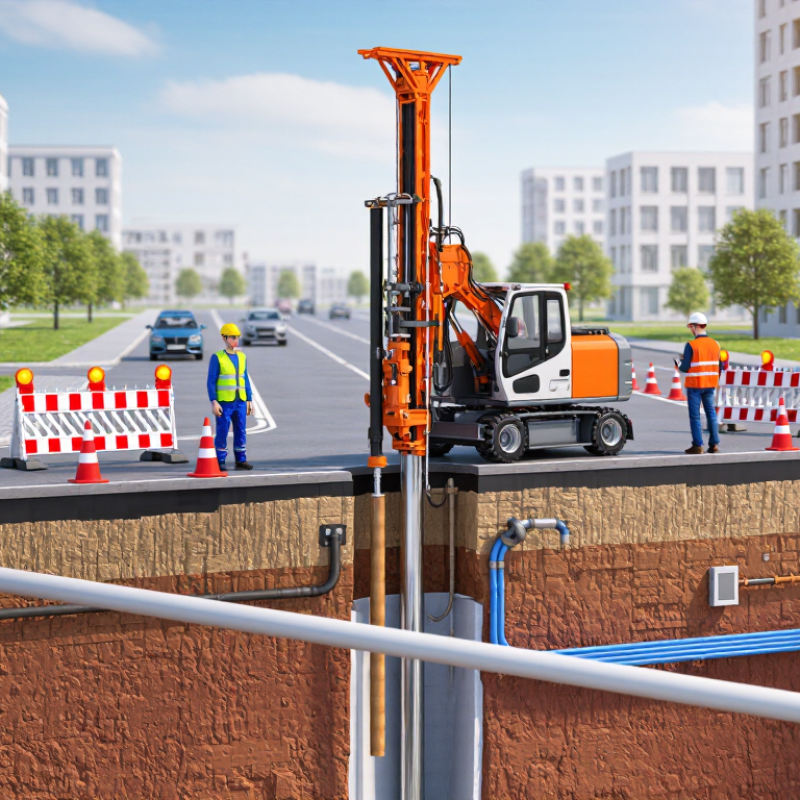
How HDD Cuts Surface Excavation by 60–90% Compared with Open-Cut Work
Why Choose a Horizontal Directional Drilling Machine?
Horizontal directional drilling can reduce surface excavation by 60–90% compared with open-cut construction. This range appears in industry guidance from the National Association of Sewer Service Companies and NASTT’s HDD good-practice materials. The reduction is practical: one entry pit, one exit pit, and a guided underground bore can replace a long, continuous trench. Roads remain more accessible. Pavement, landscaping, and mature trees face less disturbance.
The equipment also reduces restoration work. FHWA trenchless-technology guidance identifies lower traffic disruption, reduced reinstatement, and shorter work zones as major economic benefits. On a typical urban crossing, crews may drill beneath a roadway instead of removing several hundred square metres of asphalt. Less excavation can also mean fewer truck movements and smaller spoil piles. A quieter site matters to nearby residents.
But 60–90% is not a guarantee. Soil conditions, bore length, depth, groundwater, and existing utilities change the result. Poor locating can create delays. It can also create expensive redesigns. That part is often underestimated. Experienced contractors verify utility records, scan the alignment, and select drilling fluid for the ground conditions. NASTT guidance stresses planning, tracking accuracy, and proper annular-space control. A horizontal directional drilling machine works best when design and field data agree. Otherwise, the promised excavation saving may exist only on paper.
Why Choose a Horizontal Directional Drilling Machine? - How HDD Cuts Surface Excavation by 60–90% Compared with Open-Cut Work
| Project Dimension | Horizontal Directional Drilling (HDD) | Conventional Open-Cut Installation | Practical Advantage |
|---|---|---|---|
| Surface excavation | Approximately 10–40% of the work corridor, depending on entry and exit pits | Approximately 100% of the pipe alignment normally requires a continuous trench | Can reduce surface excavation by approximately 60–90% in suitable ground and alignment conditions |
| Typical exposed work area | Two compact work zones: a drilling entry area and a receiving or pullback area | A continuous trench, spoil-storage area, equipment access route, and pipe-laying zone | Less disruption to roads, landscaping, agricultural land, and developed sites |
| Road and railway crossings | Crossings can often be completed below the surface without opening the full pavement or rail corridor | Usually requires lane closures, pavement removal, trench shoring, and surface reinstatement | Fewer traffic interruptions and less pavement reconstruction |
| Waterway crossings | Designed to pass beneath rivers, canals, and drainage channels without a full-width surface trench | May require cofferdams, temporary diversion, open excavation, or extensive bank restoration | Lower direct disturbance to banks and surface water features when properly designed and permitted |
| Spoil and excavated material | Limited excavation is concentrated at the entry and exit areas; drilling fluid is commonly recycled or separated where required | Large quantities of trench spoil must be handled, stored, tested, hauled, or disposed of | Reduced spoil handling and fewer truck movements on many projects |
| Typical installation depth | Commonly installed several metres below grade, with depth selected to avoid existing utilities, foundations, and obstacles | Often installed at shallower trench depths, subject to utility clearance, soil conditions, and required cover | Provides greater flexibility for crossing obstacles and maintaining surface access |
| Typical pipe diameter range | Commonly used for small service lines through large utility installations; feasible size depends on machine capacity, soil, length, and product pipe | Broadly suitable for many diameters, but trench width and shoring requirements increase with pipe size and depth | HDD is especially valuable where large open trenches are unsafe, costly, or impractical |
| Traffic and public access | Usually maintains more of the existing road, driveway, sidewalk, or access route during construction | Continuous trenching can require longer closures, detours, temporary crossings, and access restrictions | Improves continuity of transport, pedestrian movement, and property access |
| Restoration requirement | Restoration is generally concentrated around entry and exit pits, access routes, and any temporary work pads | The full trench corridor may require backfilling, compaction, pavement repair, landscaping, and erosion control | Less surface reinstatement can shorten closeout work and reduce lifecycle disturbance |
| Best-fit applications | Roads, railways, waterways, airport areas, urban corridors, landscaped sites, and congested utility routes | Open land with adequate working width, limited obstacles, low traffic impact, and straightforward soil conditions | Method selection can be matched to site access, ground conditions, environmental constraints, and project risk |
| Key design limitations | Requires a verified bore profile, utility locating, geotechnical information, drilling-fluid management, and adequate tracking accuracy | Requires trench stability controls, shoring or sloping where applicable, dewatering, spoil management, and surface reinstatement | HDD is not universally superior; feasibility depends on geology, groundwater, alignment, tolerances, permits, and pullback design |
Planning note: The ranges shown are typical engineering-planning comparisons rather than guaranteed project results. Actual excavation reduction depends on bore length, pit dimensions, pipe diameter, soil conditions, groundwater, utility congestion, access requirements, and regulatory controls.