
What Are the Top 10 Commercial Downlight Types?
Commercial Downlights do more than brighten a ceiling. In offices, shops, hotels, and healthcare spaces, their beam shape, color quality, and controls affect how people use each room. A narrow beam can highlight a display, while a wider distribution often feels calmer across a work area. Small choices matter.
This guide examines ten common commercial downlight types, including fixed, adjustable, wall-wash, recessed, surface-mounted, fire-rated, dimmable, emergency, smart, and low-glare options. The categories can overlap; a single fixture may be adjustable, dimmable, and low-glare. That is worth remembering. “Best” depends on ceiling construction, mounting depth, maintenance access, ceiling height, and the task below. A retail fitting room needs different light from a corridor or meeting room. Check lumen output, color temperature, color rendering, glare control, driver compatibility, and product documentation before specifying a fitting. Confirm that the installation suits local requirements and the manufacturer’s instructions. A catalog photograph cannot show how a beam will look on a textured wall. Mock-ups help, though they take time and may not reveal every operating condition. This overview offers a practical starting point, not a substitute for coordinated lighting design. Some distinctions are less tidy than product labels suggest. With those limits in mind, the ten types below can help buyers and designers compare options and ask better questions before installation.
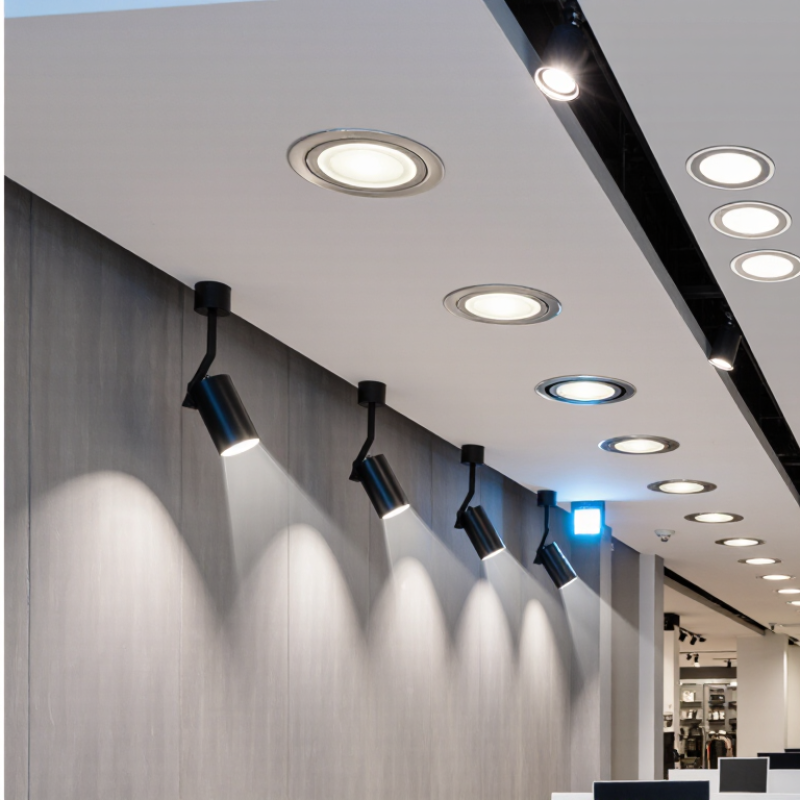
Classify Ten Commercial Downlight Types by Mounting, Optics, and Function
Commercial downlights are easier to compare when grouped by mounting, optics, and function. Recessed fixed downlights sit flush with the ceiling and suit corridors or general offices. Adjustable recessed models tilt toward displays or artwork. Surface-mounted units work where ceiling cavities are shallow. Suspended downlights bring light closer to counters or high-ceiling work areas. Track-mounted heads can be repositioned as layouts change. Check ceiling depth, fixture weight, and aiming clearance before specifying.
Optics shape what people see. Wall-wash downlights spread light across vertical surfaces, helping shelves and room edges read clearly. Pinhole models use a narrow aperture for a discreet appearance, but precise placement matters. Baffle downlights use ridged interiors to reduce visible glare from common viewing angles. Reflector downlights direct a stronger beam onto tables or merchandise; beam spread and mounting height affect the result. Small details count.
Function adds another layer. Sensor-integrated downlights can respond to occupancy, though sensor position may leave awkward blind spots. Emergency downlights provide backup illumination when normal power fails, with performance depending on the specified system and installation. These ten types overlap: a recessed unit may also be adjustable, baffled, or sensor-equipped. That is useful, but not perfectly tidy. Review sample lighting on site; ceiling finishes and real furniture can change the effect.
FAQS
Compare delivered lumens and fixture lumens per watt, not wattage alone. Also check beam angle, glare, and dimming.
A 1,000-lumen fixture at 100 lm/W uses about 10 watts. At 70 lm/W, it needs roughly 14 watts. Small differences add up across many fixtures.
Not necessarily. Room surfaces, beam spread, and fixture placement affect the result. Check tested fixture data rather than relying on the model type.
A 15° beam can highlight a small display. Angles near 60° spread light more broadly across desks or walkways. Test the actual layout.
CRI 80+ is a practical baseline for many offices. Higher CRI can help clothing, food, and artwork look more faithful. CCT from 2700 K to 5000 K covers warm lounges through crisp work areas.
No. Drivers, optics, and heat reduce system performance. Compare delivered lumens divided by fixture watts, using consistent test methods.
Install a mock-up and inspect desks, walls, and artwork. Look for harsh reflections, bright pools, or color shifts. A spec sheet may not show these problems.
No single type fits every space. Fixed, adjustable, wall-wash, and low-glare models serve different tasks. I would still check ceiling height and finishes; labels can be vague.