
China Top 10 Cable Connector Manufacturers
China’s cable and electronics sector has become a major source of Cable Connectors for automotive, industrial, telecom, energy, and consumer applications. Yet manufacturer quality varies widely. A polished website cannot prove stable production.
This guide examines China’s top 10 Cable Connector manufacturers through practical criteria. These include connector design experience, factory capacity, material control, testing systems, and export reliability. We also consider ISO 9001, IATF 16949, RoHS, REACH, IP ratings, and traceable quality records. These details matter when a connector operates inside a hot engine bay or a dusty outdoor cabinet.
Robert Mroczkowski, author of Electrical Connector Handbook, wrote, “The connector is often the weakest link in an electrical system.” That warning remains relevant. A loose crimp, thin plating, or poorly sealed housing can interrupt an entire machine. Small parts can create large failures.
The selected companies represent different strengths. Some focus on automotive terminals and wire harnesses. Others serve PCB assemblies, solar systems, fiber networks, or industrial controls. Their capabilities are not identical. Neither are their testing methods.
No ranking is perfect. Public information may be incomplete, and supplier performance can change after an audit. Therefore, this overview should support careful comparison, not replace sample testing or factory verification. Buyers should confirm contact resistance, mating cycles, thermal endurance, and delivery consistency before signing a large order.
The strongest manufacturers combine engineering discipline with responsive communication. They explain tolerances clearly. They document changes. They admit limitations. That last quality is easy to overlook, but it often protects long-term projects.
China’s Cable Connector Manufacturing Industry at a Glance
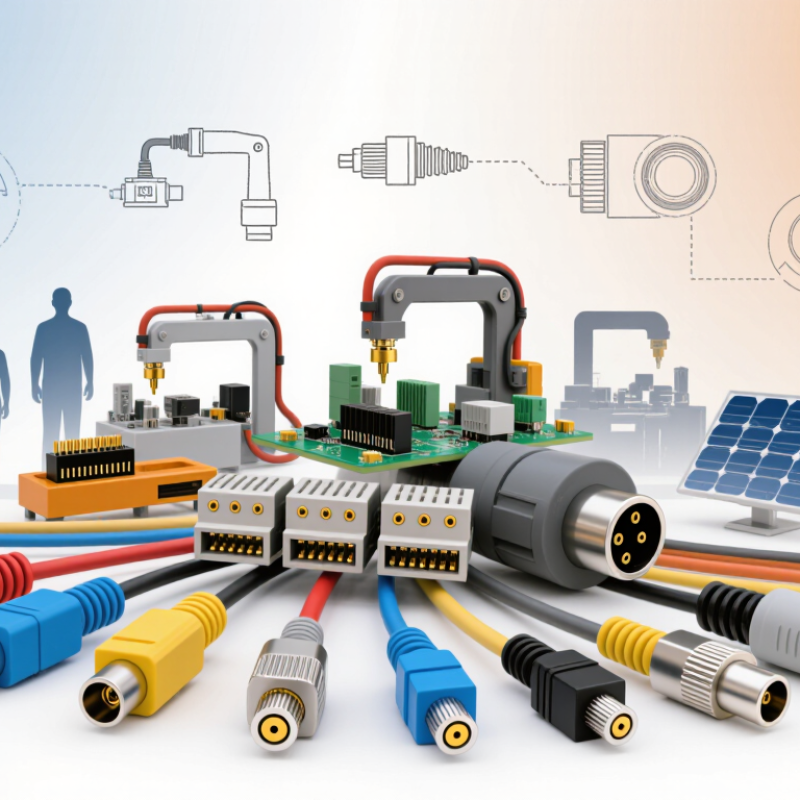
China’s top ten cable connector manufacturers reflect a layered, export-oriented production network. Factories range from precision mold workshops to integrated plants producing terminals, housings, seals, and cable assemblies. Major activity clusters around coastal electronics and automotive supply chains. The picture is diverse. Some facilities specialize in low-volume custom connectors, while larger suppliers support stable, high-volume programs. This flexibility helps buyers adjust designs without rebuilding the entire sourcing plan.
In practical supplier evaluations, process control often matters more than polished catalogs. Engineers check contact resistance, mating cycles, insulation performance, crimp quality, and resistance to vibration or moisture. A reliable factory can trace resin lots, metal batches, tooling revisions, and inspection records. Automated presses improve consistency, but skilled operators still catch defects that sensors miss. That human step is easy to underestimate. Manufacturers serving overseas markets usually follow international safety and environmental requirements, supported by laboratory testing and documented quality systems.
Cost remains a strong advantage, yet it is not the only purchasing factor. Tooling communication, sample speed, engineering response, packaging discipline, and after-sales evidence can change the real project cost. Some suppliers quote aggressively, then struggle with tolerance changes or small production runs. That is worth questioning. Buyers should compare measured samples, not promises. The industry is moving toward lighter materials, higher density, automated inspection, and connectors for electrification, data equipment, and industrial control. Progress is visible, but uneven. Smaller factories may need stronger documentation and cleaner validation routines for demanding international projects.
China Top 10 Cable Connector Manufacturers - China’s Cable Connector Manufacturing Industry at a Glance
Industry-level overview of the main cable connector product segments manufactured in China
| No. | Product Segment | Typical Technical Range | Common Standards | Primary Applications | China Manufacturing Strengths |
|---|---|---|---|---|---|
| 01 | Circular Industrial Connectors | 2–24 contacts; typically 30–300 V; IP65–IP68 configurations | IEC 61076-2 series; IEC 60529 | Factory automation, sensors, robotics, motion-control systems and industrial equipment | Broad production capacity, flexible customisation, metal and plastic housing options, and strong export compatibility |
| 02 | Rectangular Heavy-Duty Connectors | Multi-contact layouts; commonly 250–1,000 V; IP65 or higher with suitable housings | IEC 61984; IEC 60529 | Industrial machinery, rail equipment, power distribution cabinets and production lines | Integrated stamping, die-casting, plating and assembly capabilities support high-volume industrial orders |
| 03 | Industrial Ethernet Connectors | Cat 5e, Cat 6 and Cat 6A; 100 Ω balanced cabling; shielded and outdoor versions available | IEC 60603-7; ISO/IEC 11801; IEEE 802.3 | Industrial Ethernet, control networks, data centres, surveillance systems and smart factories | High-volume RJ45, M12 Ethernet and field-assembly production with automated testing and shielding processes |
| 04 | Coaxial RF Connectors | 50 Ω or 75 Ω impedance; DC to multi-GHz designs; crimp, solder and compression termination | IEC 61169 series; relevant RF interface specifications | Telecommunications, wireless infrastructure, broadcast equipment, test instruments and security systems | Extensive precision-machining and plating supply chains support SMA, SMB, N, BNC and related RF formats |
| 05 | Automotive Low-Voltage Connectors | Typically 12 V, 24 V or 48 V systems; sealed and unsealed designs; vibration-resistant terminals | USCAR-2; LV214; ISO 16750 | Passenger vehicles, commercial vehicles, lighting, body electronics and battery-management systems | Large automotive electronics supply chains, high-speed stamping and moulding, and scalable harness assembly |
| 06 | Automotive High-Voltage Connectors | Commonly 400–1,000 V DC systems; touch-safe designs; high-voltage interlock options | ISO 19642; LV215; ISO 16750 | Electric vehicles, hybrid vehicles, traction inverters, onboard chargers and high-voltage battery packs | Rapid development of EV supply chains, aluminium and copper terminal processing, sealing and automated inspection |
| 07 | Solar Photovoltaic Connectors | Up to 1,000 V DC or 1,500 V DC; commonly IP67–IP68; UV- and weather-resistant materials | IEC 62852; IEC 60529 | Solar modules, string inverters, combiner boxes and utility-scale photovoltaic installations | Strong photovoltaic component ecosystem, automated assembly and compatibility with international PV system designs |
| 08 | EV Charging Connectors | AC and DC charging formats; voltage and current vary by system; temperature and proximity-sensing contacts | IEC 62196; IEC 61851; regional charging-interface requirements | AC wall boxes, DC fast chargers, charging stations, charging cables and electric buses | Mature EV component manufacturing, precision terminals, cable overmoulding and high-volume charging-equipment supply |
| 09 | Terminal Blocks and Wire-to-Board Connectors | Typical pitch from about 2.00 mm upward; commonly 300–1,000 V; screw, spring and push-in termination | IEC 60947-7-1; IEC 60999 series | Control panels, industrial power supplies, HVAC equipment, instrumentation and building automation | Cost-efficient moulding, stamping and assembly operations support large product ranges and custom pin layouts |
| 10 | Fiber-Optic Cable Connectors | Single-mode and multimode fibre; duplex and multi-fibre formats; low insertion-loss designs | IEC 61754 series; IEC 61755 series; IEC 60874 series | Telecom networks, data centres, FTTH systems, industrial communication and medical equipment | Large-scale optical-component manufacturing, ceramic ferrule processing and high-volume connector assembly |