
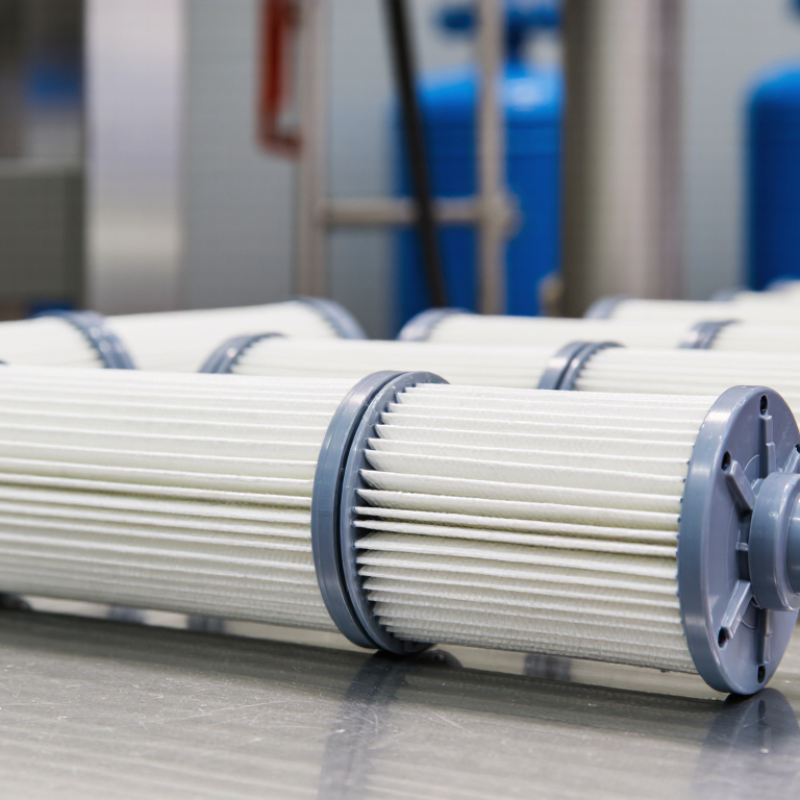
What Are High Flow Filter Cartridges?

High Flow Filter Cartridges are engineered filtration elements designed to process large liquid volumes through a compact housing. They are common in municipal water treatment, industrial process lines, cooling systems, and prefiltration applications. Unlike conventional cartridges, they often use larger diameters, pleated media, or radial-flow designs. These features increase usable surface area and help reduce the number of cartridges required.

The term sounds simple, but it can mislead. High flow does not mean unlimited flow. Actual performance depends on fluid viscosity, particle loading, pressure drop, media type, temperature, and housing design. A cartridge rated for water may behave differently with oil, chemicals, or concentrated process fluids. That difference matters.

Filtration specialist Dr. Peter S. Cartwright offers a practical reminder: “The right filter is selected by the duty, not by the label.” This principle keeps selection grounded in operating conditions rather than impressive flow claims. A buyer should examine micron rating, contaminant profile, connection style, seal material, and replacement procedure. Small details often control reliability.

High flow is only part of the decision. It may reduce changeout frequency and simplify maintenance, yet unsuitable media can shorten service life. Real systems are rarely perfect. Flow surges occur. Data sheets may not reflect every plant condition. This article explains how High Flow Filter Cartridges work, where they fit, and which limitations deserve careful attention before installation.

What Are High Flow Filter Cartridges?

Definition and Core Function of High Flow Filter Cartridges

High flow filter cartridges are large-format filtration elements designed to process more liquid through one cartridge.

Their core function is simple: remove suspended solids while maintaining useful flow and manageable pressure loss.

Unlike conventional cartridges, they usually offer greater dirt-holding capacity and longer service intervals. Many designs use pleated media inside a wide housing. This creates more filtering surface without greatly increasing equipment footprint.

However, “high flow” is not a fully standardized term. Flow rates depend on media, viscosity, particle load, and pressure.

The cartridge can protect pumps, membranes, heat exchangers, and downstream process equipment.

It may capture sediment, rust, scale, or biological particles, depending on the selected media and micron rating.

The World Health Organization and UNICEF reported in the 2023 Joint Monitoring Programme update that 2.2 billion people lacked safely managed drinking water in 2022.

This figure shows why dependable pretreatment remains important. Industrial filtration reports also identify water treatment as a major demand area.

Yet capacity figures can look impressive on paper. Real performance may fall when water quality changes suddenly.

Tips:

Check the required flow at the actual liquid temperature.

Compare clean and dirty pressure-drop data, not only headline capacity.

Confirm chemical compatibility before installation.

Record inlet pressure, outlet pressure, and replacement timing.

A small logbook often reveals problems earlier than visual inspection.

Do not select by flow rate alone. That shortcut is common, and sometimes expensive.

How High Flow Filter Cartridges Work

High flow filter cartridges clean large liquid volumes through a wider, deeper media structure. Unlike standard cartridges, they often use fewer elements with larger diameters. This reduces housing space, labor, and sealing points. The exact capacity depends on viscosity, particle load, temperature, and membrane material. A published 2024 industrial filtration market report estimates continued growth as water reuse and process manufacturing expand. Market growth alone, however, does not guarantee correct sizing.

How do they work?

Contaminated liquid enters the cartridge housing and moves across pleated or layered media. Particles become trapped on the surface and inside the media pores. Clean liquid then exits through the central core. As dirt accumulates, differential pressure rises. Operators monitor this pressure instead of guessing replacement time. A 0.7-bar increase is often treated as a practical changeout signal, but each process needs validation.

ISO 16889 uses the beta ratio to describe particle removal efficiency. For example, β5 = 5,000 means only one particle passes downstream for every 5,000 particles entering at the tested size.

That figure is useful, but it is not a promise under every operating condition. Field flow may fluctuate. Temperature may drop. The cartridge may load unevenly. A 2023 water-treatment industry report also identifies energy use and maintenance as major operating concerns, making lower pressure drop increasingly valuable. In practice, a cartridge that lasts longer but creates excessive resistance may be the wrong choice. The numbers need questioning.

Main Components and Design Features

What Are High Flow Filter Cartridges?

High flow filter cartridges combine several engineered parts. The outer housing directs liquid around a pleated or depth-filter media pack. A central support core prevents collapse under pressure. End caps lock the layers together, while elastomeric seals prevent bypass. Some designs include lifting handles. Small details matter.

The media controls particle removal, flow capacity, and service life. Pleated polypropylene can provide a large filtration area in a compact footprint. Depth media captures particles throughout its thickness, not only on the surface. A wide flow channel helps reduce pressure loss. However, a larger cartridge is not automatically better. Poor sealing can make effective filtration nearly useless.

MarketsandMarkets estimated the industrial filtration market at about USD 31.7 billion in 2024, with continued growth through 2029. This demand reflects tighter process control and rising water-treatment needs. The 2024 United Nations World Water Development Report also notes that agriculture uses roughly 70% of global freshwater withdrawals. That pressure encourages systems with higher throughput and lower replacement frequency.

During field checks, operators should inspect differential-pressure gauges, gasket compression, and cartridge alignment. These parts are often overlooked. Flow direction must match the internal support design. Otherwise, the media may deform early. I would also question every “high capacity” claim unless test conditions are clearly stated. Particle size, fluid viscosity, temperature, and test dust can change the result. Real applications are messier.

What Are High Flow Filter Cartridges? - Main Components and Design Features

Component or Design Feature Typical Construction or Specification Primary Function Performance Contribution
Filter Media Pleated synthetic, polypropylene, polyester, or cellulose-based media Captures suspended solids, particles, and selected contaminants A large pleated surface area supports high flow rates while maintaining particulate retention
Support Layer Perforated or molded thermoplastic support structure Supports the filter media against pressure and flow forces Reduces media deformation and helps preserve cartridge shape during operation
Core Rigid perforated plastic or corrosion-resistant metal tube Provides internal mechanical support and an open flow path Helps maintain structural integrity under differential pressure
End Caps Molded polypropylene or other chemically compatible polymer Seals the media and connects the cartridge to the housing Prevents bypass and ensures that liquid passes through the intended filtration area
Gasket or O-Ring Elastomers selected for temperature and chemical compatibility Creates a seal between the cartridge and filter housing Limits fluid leakage and cross-contamination around the cartridge
Pleated Geometry Deep, closely spaced pleats distributed around a large cylindrical element Increases effective filtration area without requiring a very large housing Typically lowers pressure drop compared with a flat-sheet element of similar diameter
High-Flow Orientation Large-diameter cartridge with outside-to-inside or inside-to-outside flow design Processes greater liquid volume through fewer filter elements Can reduce the number of cartridges, connections, and maintenance operations required
Nominal or Absolute Rating Common ratings range from sub-micron filtration to tens of microns, depending on media and test method Defines the target particle-removal capability Allows the cartridge to be selected according to required water or process-fluid quality
Flow Capacity Often rated from several dozen to several hundred litres per minute per cartridge, depending on fluid, viscosity, rating, and pressure drop Indicates the volume that can be treated under specified conditions Supports compact system layouts and high-throughput filtration applications
Pressure-Drop Design Media area and flow channels are designed to control clean and loaded differential pressure Balances filtration efficiency with pumping requirements Helps reduce energy consumption and delays replacement caused by excessive loading
Material Compatibility Materials are selected for compatibility with water, chemicals, oils, solvents, or process fluids Prevents swelling, degradation, extraction, or premature failure Improves service life and supports use across different industrial processes
Drainage and Venting Housing and cartridge layouts may include air-release and liquid-drain provisions Removes trapped air and facilitates safe fluid removal Improves start-up consistency and simplifies cartridge changeout
Serviceability Single-cartridge or multi-cartridge configurations with accessible sealing and locking mechanisms Allows used elements to be inspected and replaced efficiently Reduces downtime, labour requirements, and the risk of incorrect installation

Note: Actual flow rate, pressure drop, temperature limit, chemical compatibility, and particle-removal performance depend on the cartridge design, filter rating, fluid properties, and operating conditions.

Types and Industrial Applications

What Are High Flow Filter Cartridges?

Types and Industrial Applications

High flow filter cartridges remove suspended solids while handling large liquid volumes. Their wider bodies and larger filtration areas reduce the number of housings required. In practical plant evaluations, operators often notice easier maintenance and fewer cartridge changes. However, performance depends on more than flow rate.

Pleated cartridges use folded filter media to create a broad surface area. They suit cooling water, pre-filtration, and general process-water systems. Melt-blown cartridges contain layered depth media, which can capture particles throughout the filter structure. They are useful when liquid quality changes during production. Multi-layer designs combine surface and depth filtration. Membrane cartridges provide finer separation for demanding applications, including final filtration in food, beverage, and pharmaceutical processes.

Industrial selection should consider particle size, viscosity, temperature, pressure, and chemical compatibility. A cartridge rated for high flow may perform poorly with heavy solids. That detail is easy to miss. In wastewater and metalworking systems, a staged arrangement often extends service life. Coarser filtration can protect the finer cartridge downstream. In food processing, sanitation procedures and material certifications require careful verification. Pharmaceutical use demands validated performance, traceability, and controlled installation.

A clean specification sheet does not guarantee reliable operation. Field conditions can differ. Unexpected oil, fibers, or air binding may shorten cartridge life. Monitoring pressure drop and recording replacement intervals gives engineers useful evidence. Sometimes, a smaller flow target produces a more stable process. That trade-off deserves review before purchasing.

Selection, Maintenance, and Replacement Guidelines

What Are High Flow Filter Cartridges?

High flow filter cartridges support large liquid volumes with fewer housings and less floor space. Selecting one requires more than matching connection size. Check the required flow rate, contaminant type, particle size, operating temperature, and chemical compatibility. A cartridge may look suitable yet fail early under high viscosity or pressure spikes. Confirm the collapse rating and effective filtration area with technical documentation. Field experience shows that real process conditions often differ from design estimates.

Maintenance should begin with a clean installation. Inspect seals, housing surfaces, and cartridge packaging before use. Track differential pressure, flow changes, and visible process abnormalities during operation. Rising pressure usually signals loading, but unstable pressure can indicate channeling or poor sealing. Record readings consistently. Small data gaps can make a replacement decision surprisingly uncertain. Do not rely on calendar intervals alone. A fixed schedule is convenient, but not always accurate.

Tips: Set a replacement limit before pressure becomes excessive. Use clean gloves and avoid touching filter media. Flush the housing when the process allows it. Compare new readings with previous batches. If performance drops sooner than expected, investigate upstream solids, temperature changes, and installation errors. Even experienced operators miss simple causes. A careful review can prevent repeated cartridge failures.

What Are High Flow Filter Cartridges?

High flow filter cartridges process large liquid volumes through a compact filter assembly. Selection typically considers flow rate, fluid compatibility, micron rating, dirt-loading capacity, and allowable pressure drop.

Selection, Maintenance, and Replacement Guidelines

The chart shows commonly specified nominal retention ratings used in liquid filtration. A lower micron rating targets smaller particles, but actual performance depends on whether the rating is nominal or absolute, the fluid, and the cartridge design. Monitor differential pressure during operation, inspect the cartridge when pressure loss rises, and replace it when the manufacturer’s pressure limit or the process-quality limit is reached.

Go to Top