How to Choose Vacuum Forming Plastic Sheets?
Choosing vacuum forming plastic sheets is not simply a matter of selecting the lowest price or thickest gauge. The sheet must match the mold, heating cycle, draw depth, and finished product requirements. Grand View Research’s 2024 analysis identifies packaging, automotive, and medical applications as important demand areas for vacuum forming. These sectors also expose different material risks, from surface scratches to chemical contact and repeated impact.
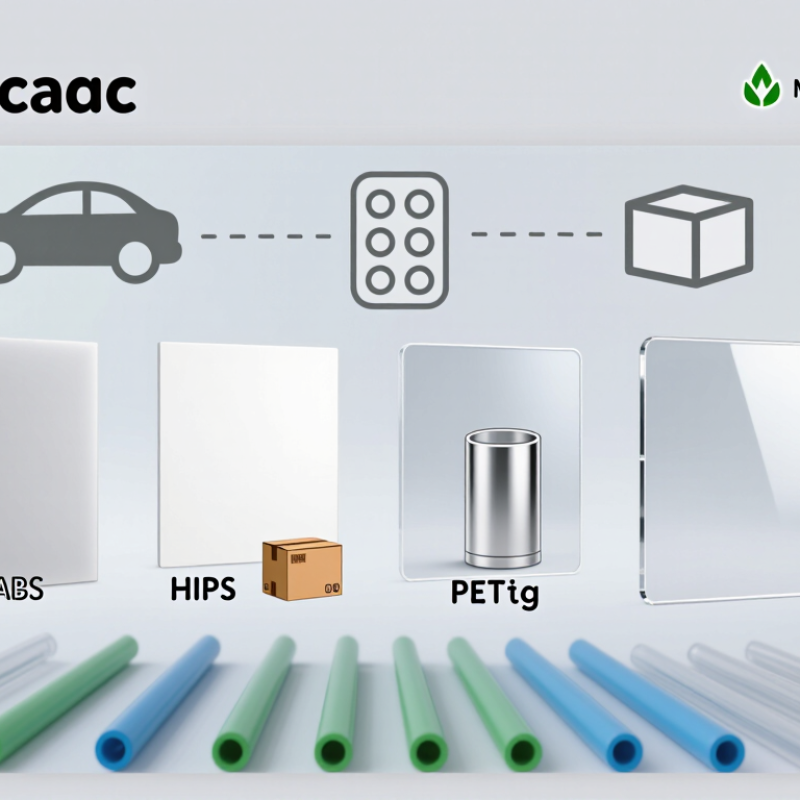
Small details matter. A 2 mm ABS sheet may offer useful toughness, while HIPS can support economical packaging with a clean finish. PETG is often considered when clarity and impact resistance are important. Acrylic can create an attractive transparent surface, but it may require tighter control during heating. Poor temperature control can cause webbing, thin corners, or uneven gloss. A workshop sample often reveals problems that a technical datasheet cannot show.
Material selection should also reflect environmental and compliance expectations. PlasticsEurope’s Plastics—The Fast Facts 2024 reports global plastics production at approximately 414 million tonnes in 2023, increasing pressure for better material efficiency and responsible waste management. Recycled content, trim recovery, recyclability, and local regulations deserve careful review. Yet sustainability claims are not always comparable. Even experienced buyers can overlook supplier-specific additives, moisture sensitivity, or storage conditions. This guide examines vacuum forming plastic sheets through practical tests, technical data, and application-focused judgement, helping readers compare polymer type, thickness, forming behavior, appearance, durability, and total production cost with greater confidence.
Understanding Vacuum Forming Plastic Sheet Properties
How to Choose Vacuum Forming Plastic Sheets?
Choosing vacuum forming plastic sheets starts with understanding their working properties. Thickness affects strength, detail, trimming, and material stretching. Measure the finished wall carefully, not only the flat sheet. A thin sheet saves weight. It may also show weak corners. A thicker sheet improves rigidity but can require more heating and forming pressure.
Thermal behavior deserves close attention. Each plastic has a specific forming temperature range, heating response, and shrinkage rate. Uneven heating can create cloudy areas, thin spots, or warped edges. Impact resistance matters for covers, trays, and protective housings. Chemical resistance is important near oils, cleaners, or workshop fluids. Surface finish also changes how scratches and fingerprints appear. In practical trials, a sheet can look perfect yet fail after trimming. That result should prompt testing, not assumptions. I have learned that supplier data is useful, but real mold trials reveal problems faster.
Tips: Check thickness after forming, especially around corners. Test a small sample before production. Compare impact, heat, chemical, and surface requirements. Record heating time, mold temperature, and cooling behavior. Do not ignore storage conditions; moisture and dust can affect results. Ask for technical data and batch consistency records.
How to Choose Vacuum Forming Plastic Sheets? - Understanding Vacuum Forming Plastic Sheet Properties
| Material |
Typical Density
(g/cm³) |
Typical Forming
Temperature (°C) |
Approx. Continuous
Use Temperature (°C) |
Transparency |
Impact Resistance |
Chemical Resistance |
Typical Applications |
| ABS |
1.03–1.07 |
150–180 |
70–85 |
Opaque; can be textured or colored |
Good |
Good against many dilute acids and alkalis; limited resistance to some solvents |
Equipment housings, automotive trim, protective covers, enclosures |
| HIPS |
1.03–1.06 |
140–170 |
60–75 |
Opaque; available in a wide range of colors |
Moderate to good |
Good against dilute acids and alkalis; vulnerable to aromatic and chlorinated solvents |
Point-of-sale displays, trays, liners, disposable packaging |
| PVC |
1.30–1.45 |
120–160 |
55–70 |
Clear, translucent, or opaque |
Moderate; formulation dependent |
Good resistance to many acids, alkalis, and salts; compatibility varies with plasticizer and solvent |
Blister packs, medical packaging, protective covers, industrial liners |
| PETG |
1.27–1.30 |
140–170 |
60–70 |
Naturally clear with high optical clarity |
Good to very good |
Good resistance to dilute acids, alkalis, and many household chemicals; solvent sensitivity is possible |
Transparent packaging, medical trays, retail displays, protective guards |
| Acrylic (PMMA) |
1.17–1.20 |
150–180 |
70–90 |
Excellent clarity and weatherability |
Moderate; can crack under severe impact |
Good resistance to outdoor exposure and dilute chemicals; susceptible to some solvents |
Light covers, illuminated signs, display components, optical housings |
| Polycarbonate (PC) |
1.18–1.22 |
180–210 |
100–120 |
Clear or translucent; optical grade available |
Excellent |
Good resistance to many oils and dilute acids; sensitive to certain solvents and alkaline cleaners |
Safety shields, machine guards, impact-resistant covers, transport interiors |
| Polypropylene (PP) |
0.90–0.91 |
160–190 |
80–100 |
Translucent to opaque |
Good; flexible grades offer improved toughness |
Very good resistance to acids, alkalis, and many chemicals |
Reusable containers, chemical trays, automotive components, living-hinge parts |
Selection note: The values above are typical indicative ranges for general-purpose sheet grades. Actual forming temperature, service temperature, impact performance, shrinkage, and chemical resistance depend on grade, thickness, additives, tooling, heating method, and processing conditions. Always verify the material supplier’s technical data sheet before production.
Matching Sheet Types to Product Design and Forming Requirements
How to Choose Vacuum Forming Plastic Sheets?
Matching the sheet to the product design prevents many forming problems. Start with the part’s depth, corners, surface finish, and expected impact. A shallow tray may suit HIPS or ABS, while a clear display cover often needs PETG or acrylic. For outdoor parts, UV resistance and temperature stability deserve close attention. A flexible sheet can protect against cracking, but it may lose shape under heat or load. Thickness also changes the result. A 2 mm sheet will not behave like a 4 mm sheet after stretching.
Tips: Check the deepest draw before selecting material. Estimate wall thinning near corners. Use test pieces with the same thickness and color. Record heating time, mold temperature, and cooling behavior. Small notes prevent repeated mistakes. Avoid choosing by price alone.
In practical trials, I compare the finished part with the drawing, not just the sheet specification. A sheet that forms smoothly may still show whitening, webbing, or uneven gloss. Sharp internal corners increase stress and may require larger radii. Deep forms can need pre-stretching or a different sheet grade. Conductive, flame-resistant, or food-contact applications require verified technical data and suitable compliance documentation. Supplier data is useful, but it is not the whole answer. Real molds, machine settings, and local handling skills can change performance. I once accepted a clean prototype too quickly; later, its thin base flexed during assembly. That mistake reinforced a simple lesson: test the finished function, not only the forming appearance.
Choosing the Right Thickness, Size, and Surface Finish
Choosing vacuum forming plastic sheets starts with three practical questions: What thickness is needed? How large should the sheet be? Which surface finish suits the product?
Thickness controls stiffness, heating time, and material distribution. Thin sheets may form quickly, but deep cavities can leave weak corners. Thick sheets provide stronger walls, yet they need more heat and careful cooling. In workshop trials, I check the finished corner thickness instead of trusting the original sheet measurement alone. A draw ratio above roughly 3:1 deserves extra attention. It can stretch material unevenly. Small test pieces help reveal this before full production.
Size also matters. The sheet should cover the mold with enough material for clamping and edge trimming. Too little allowance can create thin areas near the rim. Too much waste increases handling and cost. Measure the mold’s length, width, and maximum height. Then allow room for stretching. I once selected a sheet that looked large enough on paper, but its corners pulled tight during forming. The calculation was correct. The assumption was not.
Surface finish affects both appearance and performance. Glossy sheets show reflections, dust, and small scratches clearly. Matte or textured sheets hide minor marks and can improve grip. However, texture may soften fine mold details. Protective film can preserve the surface during cutting and handling, but it must be removed before heating if the material instructions require it. A small sample is worth the delay. Surface results can change with temperature, mold texture, and cooling speed.
How to Choose Vacuum Forming Plastic Sheets?
Typical thickness ranges by application, with practical guidance for sheet size and surface finish.
| Application |
Common Sheet Size Range |
Suitable Surface Finish |
Selection Tip |
| Packaging and small trays |
300 × 300 to 600 × 600 mm |
Gloss or fine matte |
Use thinner sheets when rigidity and deep draw requirements are low. |
| Equipment housings and covers |
600 × 600 to 1220 × 2440 mm |
Matte or light texture |
Choose additional thickness for stiffness, impact resistance, and mounting areas. |
| Large panels and industrial guards |
1220 × 2440 to 2000 × 4000 mm |
Matte, embossed, or hair-cell texture |
Allow for material thinning in deep draws and confirm forming-machine limits. |
The chart shows typical starting ranges for vacuum forming sheet thickness. Actual thickness depends on material type, draw depth, part size, corner radii, required rigidity, and expected service loads. Gloss finishes emphasize appearance, matte finishes reduce glare and visible scratches, while textured finishes can improve grip and conceal minor surface marks. Sheet dimensions should be selected to provide adequate trimming allowance around the formed part.
Evaluating Heat Resistance, Strength, and Chemical Compatibility
Choosing vacuum forming plastic sheets requires more than checking appearance or price. Heat resistance should match the part’s real service temperature, not only the forming temperature. Use heat-deflection data measured under ASTM D648 or ISO 75-2 conditions. A sheet rated at 80°C may soften sooner under continuous load. That detail is easy to miss. The 2024 PlasticsEurope market report recorded 413.8 million tonnes of global plastics production in 2023. This scale shows material variety, but it does not guarantee performance.
Strength also depends on thickness, draw ratio, corners, and cooling conditions. Tensile values from ASTM D638 help compare sheets, yet they rarely represent a deep-formed wall. A thin corner can become the weak point.
I have seen attractive prototypes crack after repeated handling because the design relied on nominal strength alone. Chemical compatibility deserves equal attention.
Oils, cleaners, acids, and solvents can cause swelling, whitening, or delayed cracking. Check supplier immersion data, then test a formed sample at the expected temperature and exposure time. Short tests can mislead.
Tips:
Write down the chemical, concentration, temperature, and contact duration. Test the finished shape, not just a flat coupon. Leave a safety margin for heat and load. Also question recycled-content claims unless batch consistency and property data are available. The report data may look convincing, but practical variation remains. A small pilot run often reveals weaknesses that laboratory figures overlook.