
How to Choose the Right Plastic Tarpaulin in 2026?
Choosing the right Plastic Tarpaulin in 2026 starts with the job it must do. A cover for garden furniture faces different demands from a truck sheet or construction shelter. Rain beads on one surface; wind pulls hard at the eyelets. Small details matter.
As a practical guide principle, materials specialist Alex Morgan puts it this way: “Match the tarp to the exposure, not just the price.” This is an editorially created line, not a verified quotation from a published source. Use it as a reminder to compare fabric weight, coating, weave, seams, and fastening points together. A thick sheet can still fail if its edges tear. A low-cost option may suit brief, sheltered use, but repeated outdoor exposure calls for stronger construction.
Start with the conditions. Will the tarp sit under direct sun? Does water pool on it after a storm? How often will it be folded, moved, and tied down? Check product specifications, warranty terms, and care instructions, rather than relying on color or vague claims such as “heavy duty.” Feel the material, if possible. Look closely at a corner seam.
There is no perfect choice. Even a well-made tarp can wear faster than expected when installed poorly or left under constant strain. This guide will compare common materials and features, so you can choose with clearer expectations—and reconsider the trade-offs before buying.
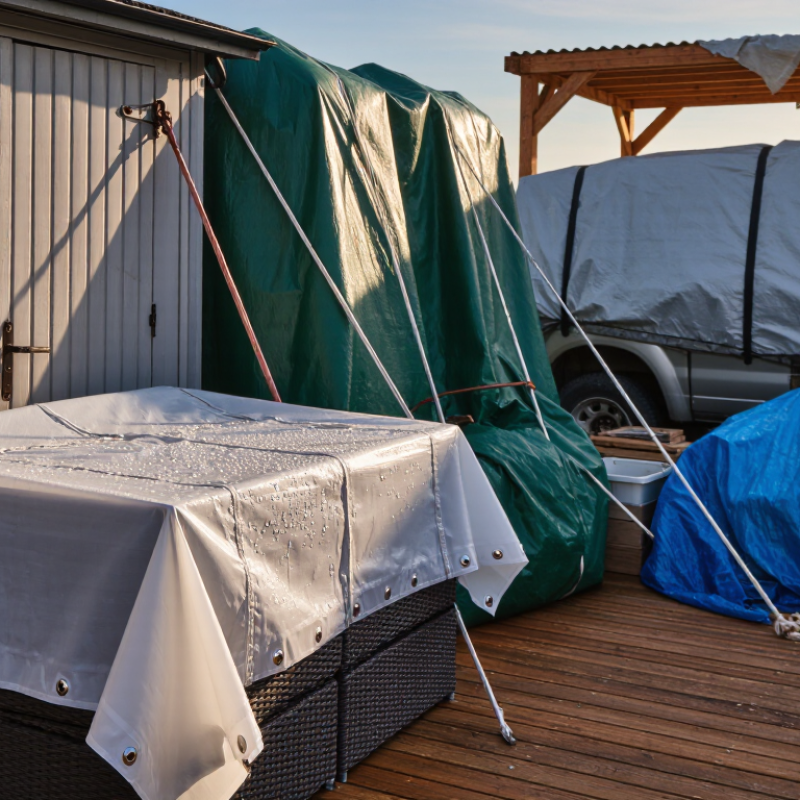
Identify the Intended Use and Exposure Conditions
Choose a plastic tarpaulin by matching the job to the conditions it will face. A temporary cover for dry indoor storage needs less UV resistance than a sheet left over a boat, load, or garden equipment all summer. Check sunlight, rain, wind, temperature, and contact with rough or sharp surfaces. Cloudy is not safe. The World Health Organization reports that up to 80% of solar UV radiation can pass through light cloud cover, so a tarp may degrade even when the sun seems weak.
Material and construction matter. Woven polyethylene with a laminated surface is common for general outdoor use; heavier coated fabrics may suit repeated handling or demanding conditions. Look beyond fabric thickness: inspect UV-stabilization claims, seam strength, reinforced corners, and grommet spacing. ASTM G154 describes controlled fluorescent-UV exposure testing, but accelerated test hours do not convert neatly into years outdoors. Ask for the test conditions and results. I would not choose by weight alone; a heavy sheet can still fail early if wind catches a loose edge or water pools in the middle.
Tips: Measure the covered object and allow room for secure tie-downs. For windy sites, choose closely spaced reinforced attachment points and avoid a loose, flapping fit. In salty or sandy locations, rinse grit off before folding; abrasion can wear the coating faster than expected.
How to Choose the Right Plastic Tarpaulin in 2026? – Identify the Intended Use and Exposure Conditions
| Intended Use | Typical Exposure Conditions | Suitable Tarpaulin Type | Useful Selection Criteria | Important Limitations |
|---|---|---|---|---|
| Short-term covering of garden furniture, firewood, or outdoor equipment | Occasional rain and sun; moderate handling; seasonal or intermittent use | Laminated woven polyethylene (PE) | Check that the fabric is coated on both sides, edges are reinforced, and eyelets are spaced appropriately for tie-downs. Compare fabric weight and stated UV resistance. | A low-cost, lightweight tarp may wear or become brittle sooner under prolonged sunlight, abrasion, or strong wind. |
| Long-term outdoor storage or repeated commercial use | Frequent handling; extended exposure to rain, sunlight, and wind | PVC-coated polyester or a heavy-duty, UV-stabilized PE tarp | Prioritize documented UV performance, reinforced hems, strong attachment points, and seams suited to the application. PVC-coated fabrics are commonly welded; PE tarp seams are often sewn or heat-sealed. | Heavier materials are less convenient to handle. Verify that the stated service conditions match the expected exposure and maintenance schedule. |
| Truck, trailer, or load covering | Road-speed airflow, vibration, rain, abrasion, and repeated securing | Reinforced PVC-coated polyester or purpose-made heavy-duty PE | Match the tarp to the load and tie-down system. Look for reinforced corners, secure attachment points, abrasion resistance, and dimensions that allow a taut fit without excessive flapping. | A general-purpose tarp is not automatically suitable for road transport. Follow applicable vehicle and load-securement requirements. |
| Shade, wind screening, or temporary fencing | Sun and wind; airflow is needed; rain protection is not the main purpose | Woven mesh or shade fabric with suitable UV stabilization | Choose mesh openness based on required shade and airflow. Check edge reinforcement and fastening spacing for the installation area. | Mesh is not a waterproof cover. Solid coverings can catch wind and impose high loads on fasteners and supporting structures. |
| Covering goods that need ventilation | Moisture may collect under a fully waterproof cover; airflow is beneficial | Breathable canvas or a ventilated cover designed for the goods | Select a breathable construction when condensation control matters. If water resistance is required, confirm the treatment and care instructions. | Breathable canvas is generally not equivalent to a fully waterproof laminated PE or coated PVC cover; water resistance can vary with treatment and condition. |
| Temporary ground sheet or surface protection | Contact with soil, grit, moisture, foot traffic, or equipment | Abrasion-resistant PE or PVC-coated fabric, selected for the expected load | Consider puncture and abrasion resistance, seam placement, and whether the tarp will be dragged or walked on. Use a protective underlayer on sharp or rough surfaces. | A tarp is not a substitute for a certified containment liner or a load-bearing safety surface. |
Selection note: Fabric weight alone does not determine service life or suitability. Check construction, UV and water-resistance claims, seam and edge reinforcement, fastening details, and the conditions specified by the manufacturer.