2026 Best Color Coated Steel Sandwich Panel Suppliers

Choosing reliable suppliers for a Color-Coated Steel Sandwich Panel requires more than comparing prices. In 2026, buyers must examine material quality, production control, technical support, and documented project experience. A strong supplier should explain core density, steel thickness, coating type, fire performance, thermal conductivity, and joint design clearly. Vague answers deserve caution.

This guide evaluates suppliers through practical criteria. These include factory capability, quality inspection, delivery consistency, customization, and after-sales service. Real experience matters. A supplier that has delivered panels for warehouses, cold rooms, workshops, or cleanroom projects can usually identify risks earlier. Look for traceable test reports, production photographs, sample approvals, and references from comparable projects. Certifications help, but they are not the whole story.

Details matter. Check whether protective film remains intact after transport. Inspect panel edges for dents, exposed cores, or uneven coating. Ask how suppliers control color variation between production batches. A low quotation may hide higher installation costs or premature maintenance. No supplier is perfect. Even experienced manufacturers can face delays, communication gaps, or unexpected raw material changes. That is why careful buyers should verify claims independently and record agreed specifications before ordering.

The following supplier review aims to support informed decisions, not promote one universal solution. Climate, building use, local regulations, and installation conditions can change the best choice. Reliable sourcing takes time. It also requires honest questions.

2026 Best Color Coated Steel Sandwich Panel Suppliers

What Are Color-Coated Steel Sandwich Panels?

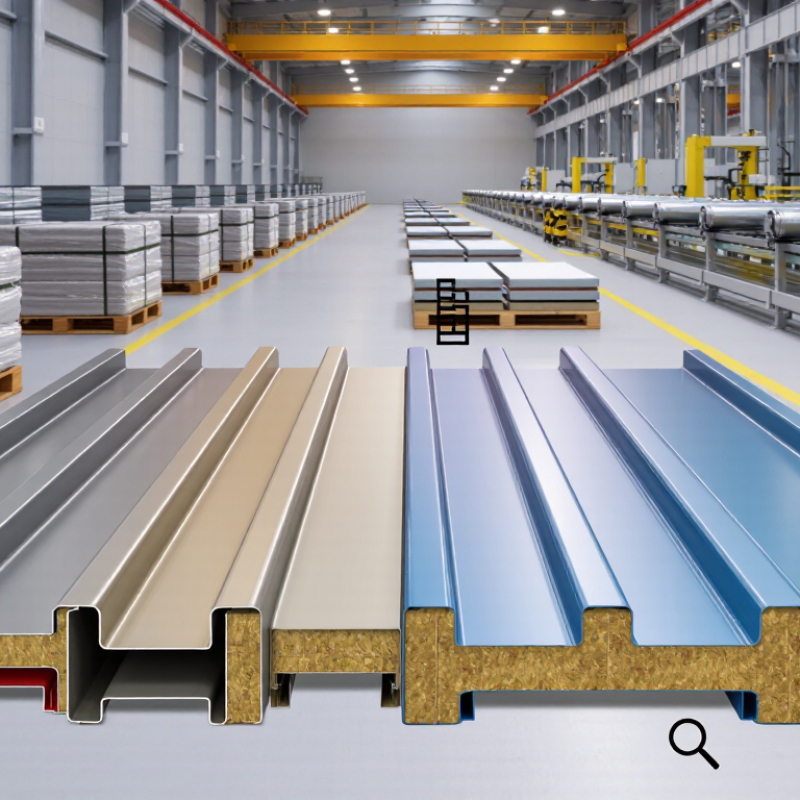
Color-coated steel sandwich panels are factory-made building elements with two profiled steel sheets surrounding an insulated core. The core may contain EPS, PIR, or mineral wool, depending on thermal and fire-performance needs. The steel surfaces receive a protective paint coating, which improves resistance to moisture, sunlight, and everyday corrosion.

On construction sites, these panels are valued for their speed. A wall panel can arrive ready for installation, with insulation already enclosed between the metal skins. Correct joint alignment matters. Even a small gap can allow water movement, heat loss, or unwanted air leakage. Panel thickness, core density, coating type, and steel gauge should match the building’s climate and use. A cold-storage room needs different performance from a workshop or agricultural building.

Appearance can be misleading. A smooth blue surface does not prove long service life. Reliable evaluation requires checking coating thickness, test documents, fire ratings, and manufacturing consistency. I have seen panels that looked excellent but had weak edge details. That weakness appeared only after repeated temperature changes. It is easy to focus on the color and forget the connection system. Installation quality also deserves attention, because damaged coatings and over-tightened fasteners can create early corrosion points. Some specifications may seem unnecessarily cautious, yet revisiting them before purchase often prevents expensive repairs.

What Are Color-Coated Steel Sandwich Panels?

Color-coated steel sandwich panels are factory-made building components consisting of protective coated steel facings bonded to an insulating core. The core material strongly affects thermal performance, weight, fire behavior, and cost. The chart compares representative thermal conductivity values for common insulation cores used in sandwich panels.

Lower thermal conductivity indicates better insulation performance. Values shown are representative typical values at approximately 10°C and may vary with product density, moisture, temperature, and applicable EN test methods. Actual panel performance should be confirmed through the supplier’s technical data.

How Color-Coated Steel Sandwich Panels Are Designed and Manufactured

2026 Best Color Coated Steel Sandwich Panel Suppliers

How Color-Coated Steel Sandwich Panels Are Designed and Manufactured

A color-coated steel sandwich panel begins with the building’s actual requirements. Engineers assess span, wind pressure, temperature changes, moisture, and fire performance. The panel usually combines two profiled steel facings with a rigid core, such as mineral wool, PIR, or EPS. Core thickness is not selected by appearance alone. It affects insulation, weight, and joint performance.

The steel coil receives cleaning, chemical pretreatment, primer, and a protective topcoat. These layers help resist corrosion and maintain color under outdoor exposure. During production, automated rollers form the facings without damaging the coated surface. The core is cut accurately, then bonded between the sheets under controlled pressure. Small gaps can create weak points. They deserve attention.

Quality checks should cover coating thickness, panel dimensions, bond strength, flatness, and locking accuracy. Inspectors also examine corners and cut edges, where corrosion may begin first. Experienced manufacturers test sample panels under heat, moisture, and load conditions. Yet no factory process is perfect. Temperature drift, uneven adhesive, or careless handling can still affect results. Supplier records, production photos, and test reports help buyers judge reliability beyond polished sales claims.

Key Factors for Comparing Sandwich Panel Suppliers in 2026

In 2026, comparing color coated steel sandwich panel suppliers requires more than checking price lists. Experienced buyers examine the complete supply chain, from coil sourcing to final packaging. Ask for recent production records, coating thickness data, core density results, and thermal conductivity reports. Reliable suppliers should explain testing methods clearly, not hide behind general claims.

Panel performance also depends on dimensional accuracy. Check joint fit, panel flatness, steel gauge, and protective film quality. Request physical samples before approving a large order. Review fire performance documentation and independent laboratory reports where applicable. A supplier with documented quality checks is usually safer than one offering the lowest quotation. Still, documents can become outdated. That is an easy detail to miss.

Tips: Compare total project cost, not only panel price. Include transport, unloading, installation guidance, replacement risk, and expected maintenance. Ask how rejected panels are handled. Confirm lead times in writing, especially during seasonal demand. Visit the production site if possible, or arrange a live quality inspection. Photos are useful, but they cannot reveal every tolerance problem.

Supplier communication deserves equal attention. Technical teams should answer specific questions about fasteners, cold storage use, wind loads, and compatible accessories. Their answers should remain consistent across sales and engineering staff. A clear warranty matters, but practical after-sales support matters more. I have seen attractive offers become expensive after small specification changes. Build a comparison sheet, record every revision, and leave room for doubt before signing.

2026 Best Color Coated Steel Sandwich Panel Suppliers - Key Factors for Comparing Sandwich Panel Suppliers in 2026

Comparison Dimension Typical Industry Benchmark Why It Matters Recommended Verification Documents Evaluation Priority
Applicable Product Standard European projects commonly reference EN 14509 for factory-made double-skin metal-faced insulating panels. North American projects may use ASTM or local building-code requirements. A clear standard confirms that the panel has been assessed for structural, thermal, dimensional, and performance requirements. Declaration of Performance, product technical datasheet, third-party test reports, and project-specific compliance statement. Critical
Core Material Options Common cores include EPS, PIR or PUR foam, and mineral wool. Each option has different thermal, fire, acoustic, and moisture characteristics. The core affects energy efficiency, fire performance, weight, acoustic comfort, and total project cost. Core material specification, density report, fire classification report, and thermal conductivity test data. Critical
Thermal Conductivity Indicative design ranges are approximately 0.035–0.040 W/m·K for EPS, 0.022–0.028 W/m·K for PIR/PUR, and 0.035–0.045 W/m·K for mineral wool. Actual values depend on product construction and test method. Lower thermal conductivity can help achieve the required U-value with a thinner panel, but declared values must be checked at the required temperature and age. Declared thermal conductivity, design thermal conductivity, U-value calculations, and test conditions. Critical
Panel Thickness Range Commercial wall and roof panels are commonly available in approximately 40–250 mm thicknesses, depending on the core and application. Thickness influences U-value, structural behavior, fire performance, joint detailing, and transportation weight. Product range chart, section drawings, thermal calculations, and structural span tables. High
Fire Performance Performance varies significantly by core, joint design, facing material, and assembly. European projects may use EN 13501-1 reaction-to-fire classes and separate fire-resistance test results. Fire classification is a life-safety and regulatory requirement; the classification of a raw core cannot replace testing of the complete panel assembly. Reaction-to-fire classification, fire-resistance reports, full-scale test certificates, and installation limitations. Critical
Steel Facing Thickness Common steel facings are often within approximately 0.40–0.80 mm, with project requirements determining the final thickness. Thicker facings can improve impact resistance, spanning capability, screw pull-out performance, and durability. Mill certificates, thickness tolerance data, panel cross-section drawings, and structural calculations. High
Metallic Coating Protection Steel substrates may use zinc or zinc-aluminium-magnesium coatings. Coating mass or thickness should be specified according to the exposure environment and applicable standard. Metallic coating protects cut edges and exposed steel from corrosion, especially in humid, coastal, industrial, or agricultural environments. Coating designation, coating-mass test results, steel mill certificate, and corrosion-environment recommendation. Critical
Organic Paint Coating Typical factory-applied paint systems may include polyester, polyurethane, PVDF, or plastisol, with nominal coating thickness commonly specified by the project. The paint system affects color retention, scratch resistance, flexibility, weathering, and suitability for aggressive environments. Paint-system technical data, coating-thickness inspection report, accelerated weathering results, and warranty terms. High
Color and Gloss Stability Color performance depends on pigment, resin system, solar exposure, panel orientation, and environmental conditions. Light colors generally absorb less solar heat than dark colors. Stable appearance reduces maintenance and replacement risk on façades and roofs exposed to ultraviolet radiation. Color reference, gloss specification, accelerated UV test data, color tolerance policy, and warranty exclusions. Medium
Dimensional Tolerances Tolerance requirements should cover panel length, width, thickness, squareness, flatness, joint geometry, and facing alignment according to the applicable product standard. Accurate dimensions reduce installation gaps, thermal bridges, water leakage, and visible alignment defects. Quality-control plan, inspection records, tolerance table, sample inspection report, and joint-detail drawings. High
Joint and Weather-Tightness Design High-quality systems normally define interlocking joints, sealant locations, fastener positions, flashing details, and roof drainage interfaces. Panel joints are critical areas for air leakage, water penetration, condensation, and thermal bridging. Installation manual, joint section drawings, air-tightness or water-tightness test results, and approved accessory list. Critical
Structural Load Capacity Capacity depends on panel thickness, span, facing thickness, support spacing, wind or snow load, temperature, and fixing arrangement. A panel suitable for one span or climate may not be suitable for another; generic load claims should not replace project calculations. Load-span tables, structural calculation, wind and snow assumptions, deflection limits, and fastener design data. Critical
Moisture and Condensation Control The design should consider vapor control, indoor humidity, outdoor climate, panel joints, penetrations, and thermal bridges. Poor moisture control can cause corrosion, mold growth, reduced insulation performance, and premature panel failure. Condensation-risk calculation, vapor-control guidance, permeability data, and detailing for penetrations and cut edges. High
Production Capacity and Lead Time Lead time should be quoted separately for standard colors, non-standard colors, special lengths, accessories, and peak-season orders. Confirm available monthly capacity rather than relying only on a standard estimate. Reliable production planning reduces project delays and helps coordinate foundations, framing, logistics, and installation crews. Production schedule, capacity statement, order-to-delivery timeline, factory acceptance process, and delay-management procedure. High
Quality Assurance and Traceability A robust system should trace raw steel, coating batch, core production, panel batch, inspection results, and packing records. Traceability makes it easier to identify defects, verify conformity, and manage warranty or replacement claims. Quality manual, inspection and test plan, batch-number system, calibration records, and non-conformance procedure. Critical
Packaging and Transport Protection Packaging should protect painted surfaces, panel edges, joints, and corners from moisture, impact, abrasion, and improper lifting during transport. Many surface defects occur during handling rather than manufacturing, so packaging quality affects delivered product condition. Packing specification, loading photographs, lifting instructions, moisture-protection method, and transport damage procedure. High
Technical Support Support should include shop-drawing review, fixing guidance, cutting instructions, accessory coordination, and responses to site questions. Technical support helps prevent installation errors that can compromise fire, thermal, structural, and weather-tightness performance. Installation manual, design-support scope, response-time commitment, detail library, and training materials. High
Warranty Clarity Warranty terms should separately address panel integrity, coating performance, color change, corrosion, installation conditions, maintenance, and exclusions. A clear warranty reveals the supplier’s assumptions and prevents disputes over environmental exposure or installation responsibilities. Signed warranty document, coating warranty, product warranty, maintenance requirements, and claim procedure. High
Sustainability and End-of-Life Information Relevant information may include recycled steel content, environmental product declarations, manufacturing waste controls, energy use, and recyclability of steel facings. Documented environmental data supports green-building assessments and more transparent lifecycle comparisons. Environmental Product Declaration, life-cycle assessment, recycled-content statement, and waste-management records. Medium
Total Installed Cost Compare panel price together with accessories, fasteners, flashings, transport, unloading, installation, maintenance, energy performance, and expected service life. The lowest purchase price may create higher lifecycle costs if it requires more maintenance or causes installation and performance problems. Itemized quotation, accessory schedule, delivery terms, installation estimate, maintenance assumptions, and lifecycle cost comparison. Critical
Note: The benchmark values are general industry reference ranges for supplier comparison. Final selection should be based on the project location, building code, structural calculations, fire strategy, climate exposure, installation method, and verified product documentation.

How to Evaluate Supplier Quality, Certifications, and Service

2026 Best Color Coated Steel Sandwich Panel Suppliers

A reliable supplier should show more than attractive panels and a polished website. Check the steel grade, coating thickness, core density, thermal conductivity, and panel dimensions. Ask for recent test reports, not only scanned certificates. The report should identify the product, testing method, laboratory, and date.

Certifications deserve careful review. Verify the certificate number, validity period, issuing organization, and exact production scope. ISO 9001 can indicate controlled processes, but it does not prove fire performance or long-term durability. For construction projects, request applicable standards such as EN 14509 or relevant ASTM specifications. A factory visit can reveal details that documents miss, including edge alignment, adhesive coverage, and storage conditions. I have found that small production records often tell more than promotional claims. Still, no checklist is perfect.

Tips: Order a physical sample. Measure coating thickness and panel size independently. Ask how rejected panels are recorded. Confirm fire, wind-load, and insulation data for your project’s climate. Evaluate service as carefully as materials. A capable supplier provides clear drawings, realistic lead times, protective packaging, installation guidance, and responsive technical support. Request warranty terms in writing, including exclusions and replacement procedures. Slow replies before payment may become slower after delivery. That warning is easy to ignore, and I have sometimes underestimated it.

Major Applications and Future Trends in Sandwich Panel Solutions

Color coated steel sandwich panels are moving beyond basic warehouse walls. In cold storage, their continuous cores reduce heat transfer around loading zones and service corridors. Food facilities use smooth coated surfaces for faster cleaning and tighter hygiene control. Construction teams also install them in workshops, agricultural buildings, retail units, and modular offices. On site, lighter panels can shorten lifting time and reduce wet trades. That advantage depends on accurate joints.

Experienced buyers examine more than price. They check core density, coating thickness, fire performance, thermal conductivity, and documented production controls. Panel geometry must match the building span, fixing system, and local weather exposure. A small gap at a corner can admit moisture and weaken long-term performance. Supplier reliability matters through sample testing, batch records, installation guidance, and responsive technical support. Details matter. These practices reveal expertise better than polished sales language.

Future solutions will pursue lower-carbon materials without sacrificing fire safety or service life. Manufacturers are testing higher recycled steel content, low-impact insulation, and coatings with longer color retention. Digital product passports may connect each panel to composition, test data, and recovery options. Factory-cut modules could also reduce site waste. Some systems may include embedded sensors for humidity and temperature monitoring. Useful, but not effortless. Installation crews will need new training, and designers must verify sensor accuracy. No panel solves every building problem. Overlooked ventilation, drainage, or damaged edges can still cause expensive failures.

Go to Top